
Lybster
At a Glance
Download Printable Guide
Contacts: HM . Very Part Time.
This is a very popular little harbour between Wick and Helmsdale
(bit closer to Wick by a couple of miles) and if you are not in a
hurry makes a pleasant stopping point on a cruise around the Moray
Firth. The harbour has been developed over the centuries and, of
course, was a busy place during the fishing boom. It is interesting
to note that the railway didn't arrive here until very late in the
nineteenth century so, to a certain, extent they missed the boat
and most of the harbour's distribution was of cured fish via the
North Sea to the Baltic and Europe as overland communication from
here, pre steam, was horse and cart.
The village is divided into Upper Lybster and Lower Lybster (the
harbour). The upper village is a ribbon development along either
side of the road to the harbour from the coast road. The road down
to the harbour (or up, from depending on where you start!) is steep
and windy affording a good view of the harbour and at one point
crosses a venerable bridge over a picturesque glen and waterfall.
The harbour is, sort of, off the beaten track unless you are
looking for it, especially from the land; and from the sea, if it
weren't for its prominent light house, you'd miss it altogether
along with the other little harbours in the coves along this
coast.
Anyway, for some reason the local Laird (a Captain Sinclair)
decided to develop Lybster and the layout of the village on the
cliffs is still as he designed it. By 1845 (only a hundred years
after Culloden) the harbour was home to a couple of hundred boats
and was booming; it is hard to imagine what it would have been
like; the population grew to over three thousand, all of them
employed in the catching, curing, and export of herring; there were
fishermen, coopers, gutters, smokers, curers and countless
labourers who by 1859 supported a fleet of over 350 boats.
There was a problem though, Lybster was very vulnerable to the
vicious storms which pound these latitudes during the winter and
the harbour was wrecked several times, each time being rebuilt even
stronger until no one (including the Government) would fund it any
more. That, and the failure of the railway to cash in on the boom
here, meant that Lybster was one of the first ports to suffer from
the decline in the fisheries; it never had steam winches etc for
offloading catches and was narrow in access and was on its way out
even before the railway was on its way in!!
You can imagine what it was like approaching low tide with a couple
of hundred boats all trying to get in and find somewhere convenient
to land their catch; it must have been bedlam so it is unsurprising
that the fishermen started to move to larger harbours.
There were attempts to revive it after the First World War but
these failed; the inner harbour wasn't built until the 1950s and,
although it struggles on, it's a brute of a place to get to by road
transport so the fishing is back to what it was centuries ago,
albeit served by power boats instead of rowing skiffs, but it's a
bit of potting, long lining and some small beam trawlers.
Of note is the recent development of Waterlines in one of the old
warehouses on the harbour. This is a combined museum,
café and amenities building and you will have to visit
here to get a key to the toilets. It's a quiet spot frequented by
fishermen, yachties and ornithologists in equal measure; the hike
up to the village is long and steep so if you are looking for
provisions you'll need your going-ashore trolley
There is a Dylan Winters Keep Turning Left video which includes this harbour. Lybster starts about minute 26
Lybster
Approach
There are no large scale charts of Lybster and even zooming in ....
.... with Sea Clear gives little indication of the orientation
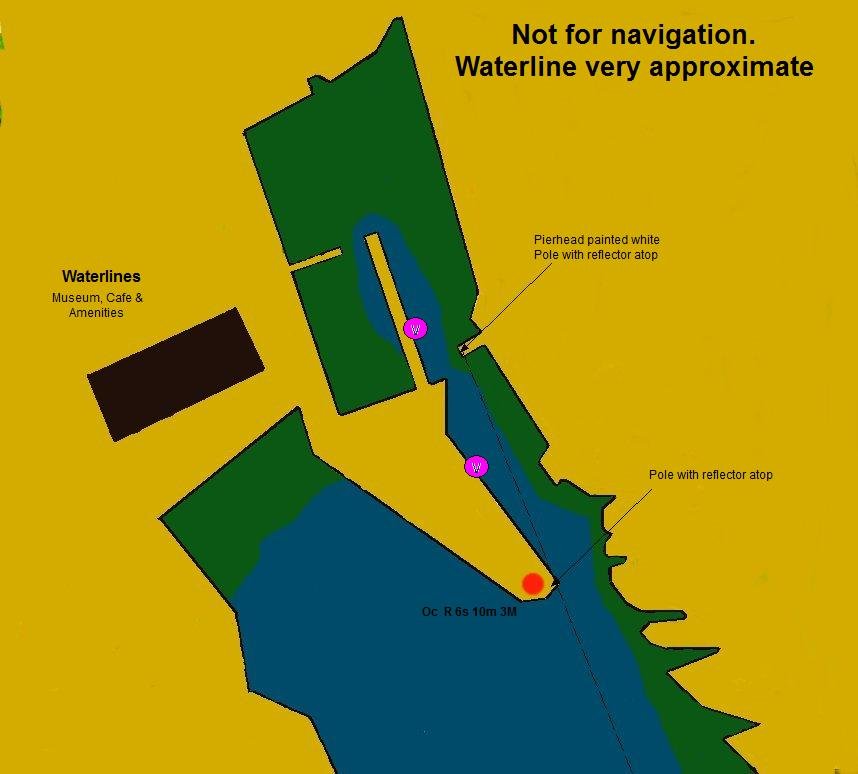
of the harbour. A look at our Google maps link (if you have
internet on board) gives one a good idea. Our chartlet is a
freehand schematic of the harbour and also will give you some idea
of what you are approaching but do not try to use it for
navigation, the low water line is especially approximate.
You should approach the harbour from our waypoint on a heading of
350°T; the cliffs on the starboard side are fringed with rocks so
if you can see into the harbour on your approach you are too far
over to the right. In good visibility you may be able to make out
the leading marks, a couple of rusty scaffold poles with small
radar reflectors on top, one situated on the south pierhead beside
the light house and one beyond that on the second pier along on the
starboard side of the channel and visible over the top of the wall
(See the chartlet).
Our photographs of the approach (forgive the poor quality) do not show them because they were not identified during the approach and we were possibly a little left of the ideal course. In Southerly winds, the seas break around the pierhead but one should still hold that 350°T course until very close to the pier and then jink round it into shelter; in that way you avoid being pushed against the cliffs on the starboard side of the approach. The harbour entrance is impassable in strong SE to SSW winds but well sheltered from the SW through North to ESE.
£ GMT
Waypoint
Charts
Rules & Regs
Hazards
Tides
Berthing
You are unlikely to find a mooring against the wall in the inner harbour....
.... but should adverse winds set in whilst you are here, a bit
of negotiation with the local berth holders will secure you a berth
alongside one of the FVs. There's normally plenty of room against
the South Wall but be careful of keep creels hanging off the wall.
In certain sea states a bilge keeler may suffer from bilge keel
boogey (a condition where the boat rocks metronomically from beam
to beam with no apparent sea running) but an angel on one of the
breasts ropes will normally cure this.
This is a private harbour and there is no harbour master in regular
attendance to allocate space to you; if you find a berth empty in
the inner harbour it will have permanent mooring ropes and a piles
of creels beside it; don't tie up there because its owner will be
back at the bottom of the tide and will ask you to move.
The harbour dues in 2012 were £15 per night which were collected by
the people in the Waterlines café; this fee covered use
of the toilets block which housed free showers and laundrette. The
free laundrette makes it a very good deal!!
2023. The Waterlines Cafe is open intermittently during this summer season so, at the moment there is no-one to collect Harbour Dues and although the toilets are available when they are open, there are no longer any showers.
Facilities
As has been said there are showers, toilets and a laundrette
located in the Waterlines building. Fresh water may be obtained
from a tap on the south side of the inner harbour. There is no
shore power and, contrary to the information in whatever pilot book
or almanac you consult, there is no fuel here, the garage closed
several years ago and the nearest fuel is at Wick.
You will find limited provisions in a mini-market in the Upper
village and there's a Post Office, bank and ATM there as well.
What to Do
Up in the village on the cliffs there are a couple of pubs, a fish and chipper and a restaurant in the upper village but it is not renowned for its night life. At the far end at the junction with the main road is the Portland Arms Hotel/Restaurant which appears to serve good food.
History
Local Business
Uncategorised
Tide Information for lybster
June 2026 | |||||||||||||||||||||||||||||||||||||||||||||||||||||||||||||||||||||||||||||||||||||||||||||||||||||||||||||||
|---|---|---|---|---|---|---|---|---|---|---|---|---|---|---|---|---|---|---|---|---|---|---|---|---|---|---|---|---|---|---|---|---|---|---|---|---|---|---|---|---|---|---|---|---|---|---|---|---|---|---|---|---|---|---|---|---|---|---|---|---|---|---|---|---|---|---|---|---|---|---|---|---|---|---|---|---|---|---|---|---|---|---|---|---|---|---|---|---|---|---|---|---|---|---|---|---|---|---|---|---|---|---|---|---|---|---|---|---|---|---|---|
| |||||||||||||||||||||||||||||||||||||||||||||||||||||||||||||||||||||||||||||||||||||||||||||||||||||||||||||||
Please note: It is the user's responsibility to ensure that the data is suitable for their intended purpose. VisitMyHarbour must not be used by vessels for navigation.