
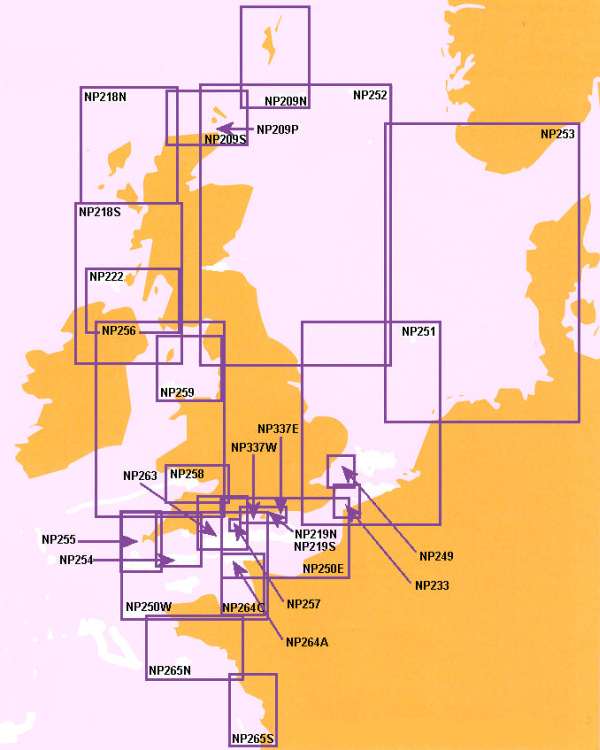
The key below shows the area coverage of the various atlases:
General notes about tidal streams
Tidal streams – Where the tidal streams are semi-diurnal information regarding them is usually given, in a convenient part of the chart, in tabular form or by notes, special symbols being inserted at the positions to which the information refers. In certain cases, where the information available is incomplete, the streams are indicated by means of arrows.
There are many places where the tidal streams cannot be predicted by reference to the tide at a Standard port. Although no data for predicting the times at which they flow is given, their general direction is, in many cases, indicated by arrows on the charts. For a few of the straits and channels, where these conditions exist, tidal stream predictions are given in Admiralty Tide Tables.
Tidal streams, particularly if rotary, may vary considerably both in direction and rate; predictions of the stream must therefore always be considered approximate.
The turn of the tidal stream is not usually coincident with the times of high and low water; in fact, though in estuaries, harbour entrances etc., the stream usually turns at about the times of high and low water, in open channels, and along open coasts generally, the turn usually occurs more nearly at half tide. Predictions of the times of high and low water must therefore never be used as predictions of the times of slack water.
It should be remembered that, even where the general direction of the stream is parallel with the shore, an indraught is usually experienced when crossing the entrances to bays and inlets.
Notes about using these tidal atlases, please read first.
Tidal atlases are A4 size booklets that display the rates of the tidal streams around our coasts in an easy to digest manner. Each consists of 13 or more diagrams showing the speed and directions of the tidal streams at any given hour, before or after high water at a standard (and specified) port. The mariner estimates where he will be at a certain time, and can consult the NP Tidal Atlas to see what effect the tidal streams will be having on his vessel at that time. Stream rates are given in knots (as opposed to MPH or M/sec) for Spring tides and Neap tides, some estimation is required for in between tides. The format and samples are below:
01,02 would mean 0.1 knts at neaps and 0.2 knts at springs
15,32 would mean 1.5 knts at neaps and 3.2 knts at springs
Most of these are on display within this "Tidal Stream" section. They are in Zoomify "Full Screen" viewers, and you can scroll through the hourly changes with ease. They may be useful for planning purposes.
We recommend that you purchase and keep on board your local NP Tidal Stream Atlas in hard copy. Around our coasts you'll be using it a lot !