In simple terms, the tide can be thought of as moving across the oceans and along coastlines. Around Great Britain, the progress of the tide follows a recognisable pattern, which is shown in the diagram below.
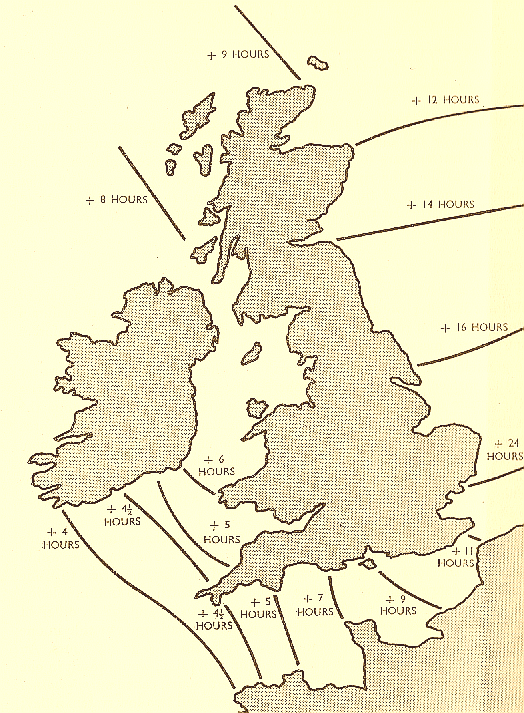
The tidal cycle takes about 12 hours, and its movement can be described approximately as follows:
- At 0 + 2 hours, it reaches the coast of Portugal.
- At 0 + 3 hours, it reaches the west coast of France.
- At 0 + 4 hours, it reaches Land’s End.
From Land’s End, the tide divides into two main paths:
One part travels eastward up the English Channel and reaches the Straits of Dover at about 0 + 11 hours.
The other part moves northward around the west coast of Ireland:
- At 0 + 9 hours, it reaches west of the Orkney Islands and then enters the North Sea.
- At 0 + 12 hours, it reaches the area off Peterhead.
- At 0 + 24 hours, it reaches the area off Harwich.
Off Harwich, this tide meets the following tide, which began in the mid-Atlantic at about 0 + 12 hours and has travelled up the English Channel through the Straits of Dover during that time.
This description is a simplified way of showing how the timing of the tide progresses around the British Isles.
Adapted from the Admiralty Manual of Seamanship, Volume II, 1951