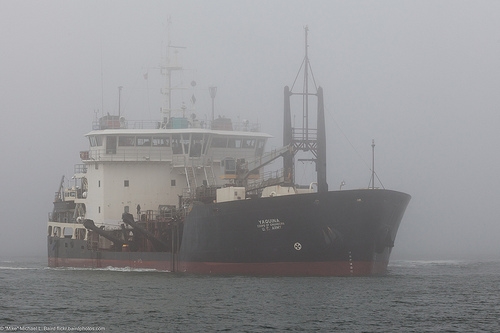
AIS receivers for small boats can be considered an aid to navigation, allowing the skipper to monitor and track large ships in his vicinity. Primarily the skipper would use this as a collision avoidance tool. It is similar to radar, but not the same. For instance it can't detect landmass, small craft, rain squalls, etc.
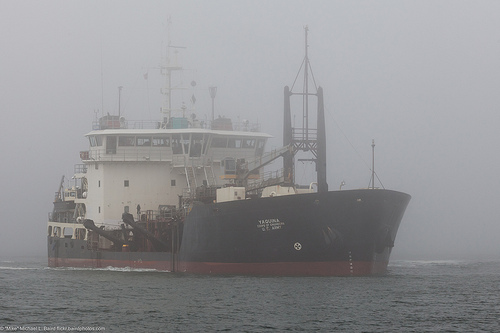
Vessels fitted with AIS transmitters (Ships over 300 GRT and all
passenger vessels), send out on VHF channels (Channel 87 and 88)
data concerning their course, speed over the ground, rate of turn,
position, true heading and the vessel's Maritime Mobile
Service Identity (MMSI) – a unique nine digit
identification number. An AIS transceiver sends this data every 2
to 10 seconds depending on a vessel's speed while underway,
and every 3 minutes while a vessel is at anchor.
Other information is transmitted every 6 minutes: IMO ship
identification number, radio call sign, name, type of ship/cargo,
dimensions of ship, draft of ship, and the destination and ETA
(down to the crew entering this information diligently !)
The same messages are broadcast alternately on the 2 separate
channels in case of heavy interference. Therefore it is possible to
have one ship transmitting on channel A, at the same time as
another ship transmitting on channel B. There are systems in place
to avoid 2 ships transmitting at the same time on the same channel
and interfering with each others transmissions. Receivers for the
leisure market fall into 2 different classes, those that monitor
the 2 channels continuously, and those that jump between the 2
channels (or fix themselves on just one).
Bearing in mind exactly the same messages are broadcast on both
channels, for leisure use in a slower boat (sailing-yacht) the
cheaper receiver is probably sufficient. (This is
not precisely true, as the ship may have moved position slightly in
the 2 to 10 seconds between transmitting on one channel and then
the other )
For a faster motor yacht, capable of 20 knts +, it may be worth
going for the dual channel receiver. At these speeds it has a
better chance of collecting the relevant information quickly enough
to be of use at high speed.
Given a bit more time (we're only talking minutes) the
single channel receiver will pick up all the same messages.
Receivers that continuously jump between the 2 channels are always
at risk of being just "out of synch" with a ships
transmissions. Eventually the transmitting ship and receiver will
be in synch and the message will be received. As always there are
pros and cons to each method.
The range depends on aerial positioning, but with a decent separate
VHF aerial mounted on the stern rail (doubles up as an emergency
VHF in case of dismasting etc), the range is likely to be about
12-15+ miles in all directions for receiving Class A (Big Ship)
transmissions. Smaller ships and leisure craft can use
"Class B" transmissions at lower power and
transmit less frequently. The likely range for receiving these
"Class B" messages is likely to be significantly
less than the Class A ones (due to height of antenna, power of
transmission, and less messages sent).
The advantages of an AIS receiver for the yachtsman/leisure
boater:
- 1. The ability to see what shipping is around, inc course and speed.
- 2. The ability to know a vessels callsign, and be able to contact via VHF, with no confusion of identity.
- 3. The ability (similar to radar) to draw a bearing line and distance rings. If the ship steadily approaches along the bearing line you are on collision course.
- 4. AIS only uses a tiny fraction of the power a radar system does (great for sailboats).